JWC Academy 创办人兼首席咖啡师。2017 世界拉花大赛全球第 10、三届马来西亚拉花冠军。带领团队培训超过 300 名咖啡师。
Coffee Knowledge · Advanced
Water · Minerals · SCA Standard
You’re not brewing coffee — you’re brewing water
Lucas Eng
Principal, JWC · 10th Place, 2017 World Latte Art Championship
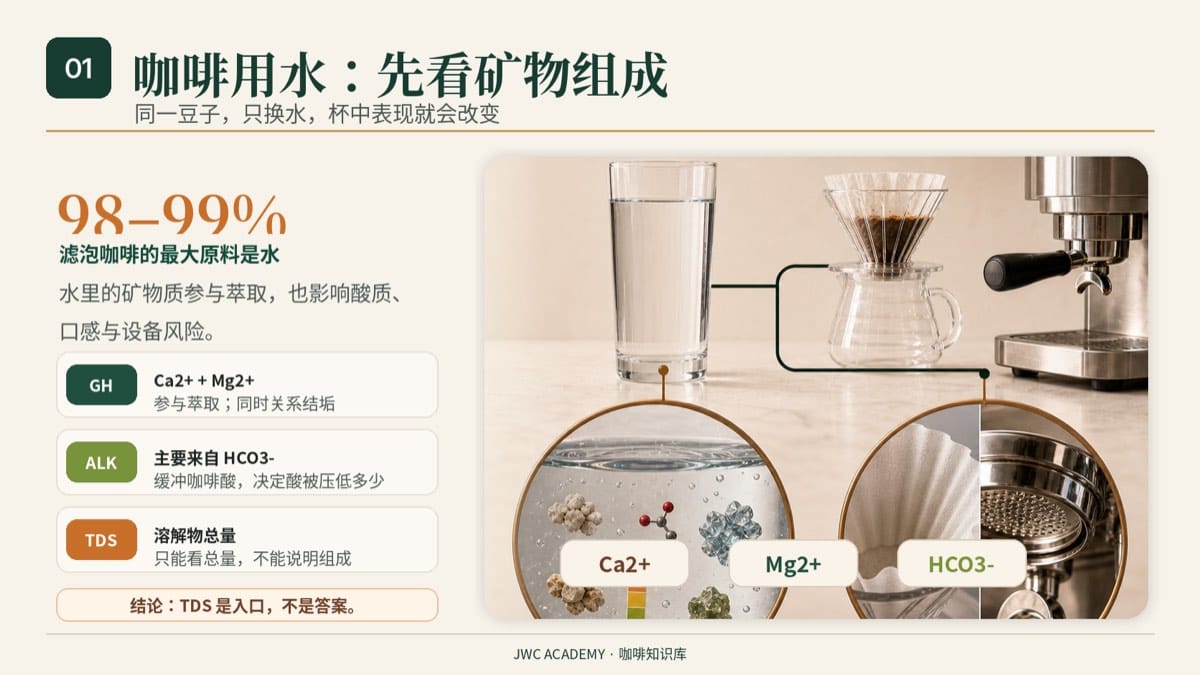
Straight answer: a cup of pour-over coffee is 98–99% water. What really shapes flavour is three minerals — magnesium pulls bright fruit acidity, calcium gives body, and bicarbonate is the brake that tames acid. Understand these three levers, then build your own water from pure water plus two salts, and you can turn an “okay” cup into a stunning one.
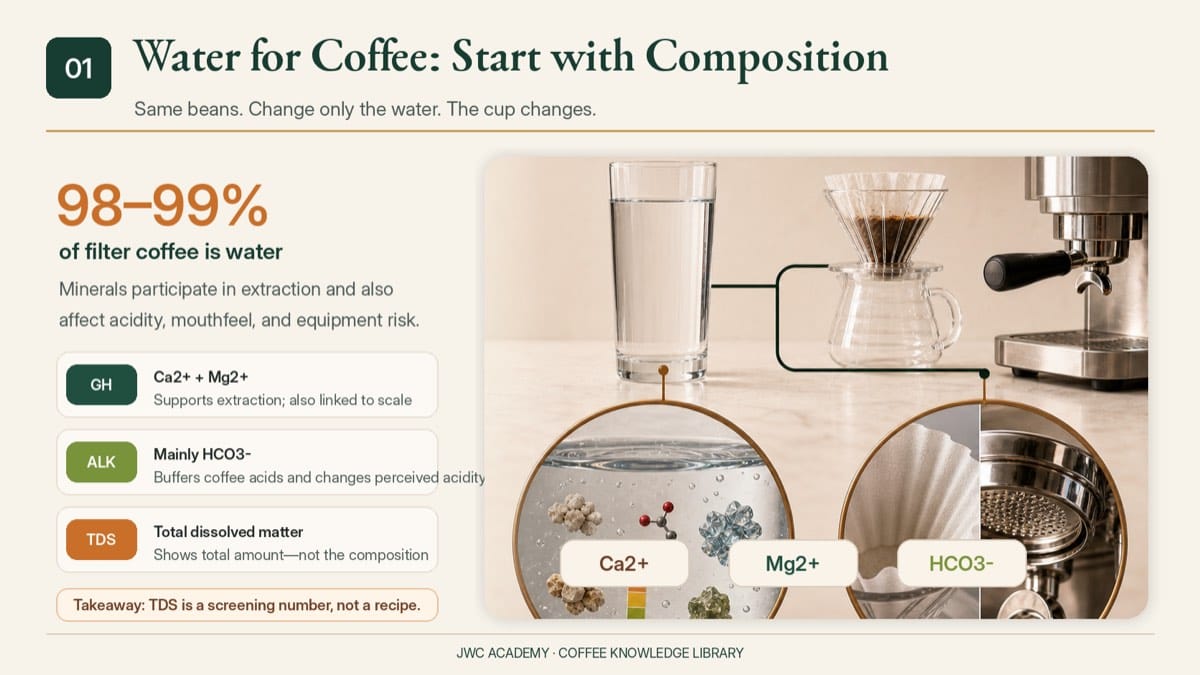
A cup of coffee is 98% water — its minerals actively drive extraction
Keep the beans, dose, ratio and temperature identical, swap only the water, and the same coffee can go from bright and juicy to flat and bitter. That’s not mysticism — the minerals in water actively take part in extraction, deciding which flavour compounds get pulled out, and how much. This guide covers three things: which parts of water matter, where each mineral steers the flavour, and how to build your own ideal brew water from pure water plus salts.
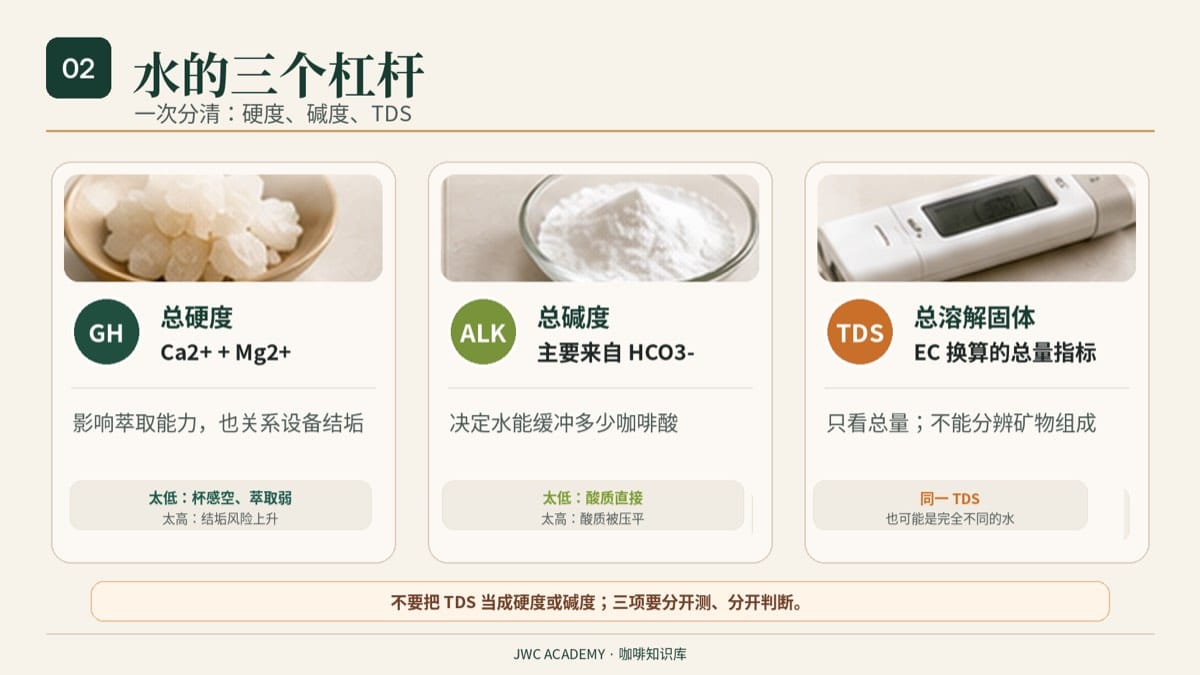
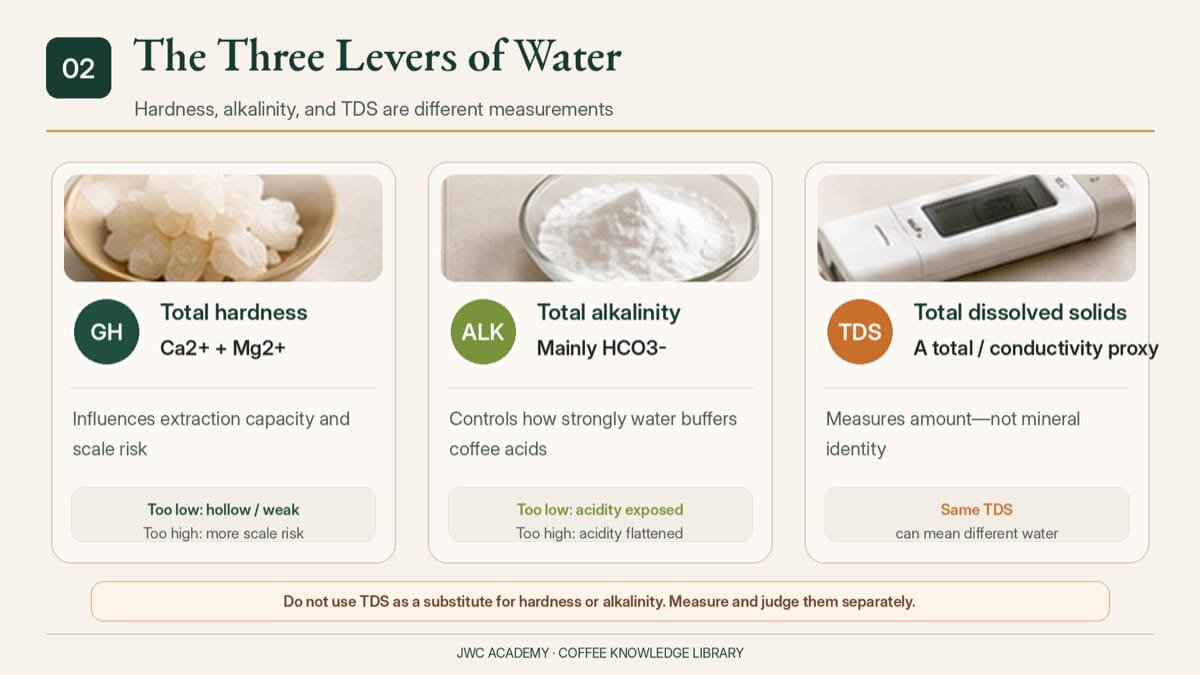
The three levers: hardness, alkalinity, TDS
Forget the intimidating chemistry. For brewing, you only need to watch three numbers.
Hardness = the muscle, alkalinity = the brake, TDS = total minerals
Total hardness GH (calcium + magnesium) — the “muscle.” Calcium and magnesium do the heavy lifting: they bind coffee’s flavour compounds and pull them into the water. Too low (near-pure) → no drive, the cup tastes hollow and thin; too high → over-extraction and bitterness, plus limescale in your kettle and espresso machine.
Alkalinity KH (bicarbonate) — the “brake” on acidity. Alkalinity is the water’s buffering power. Too low → sharp, unstable acidity; too high → acids get flattened and the cup tastes dull, chalky, almost stale. It’s the invisible culprit many overlook — tap water in much of Malaysia runs high in alkalinity, a common reason home brews never taste as bright as the café’s.
TDS (total dissolved solids) — the “total amount.” TDS is the sum of everything dissolved, a rough proxy for mineral concentration. ⚠️ A TDS pen only measures the total, not the composition. Two waters both reading 150 TDS can taste completely different. A pen rules out extremes, but can’t tell you whether the water tastes good.
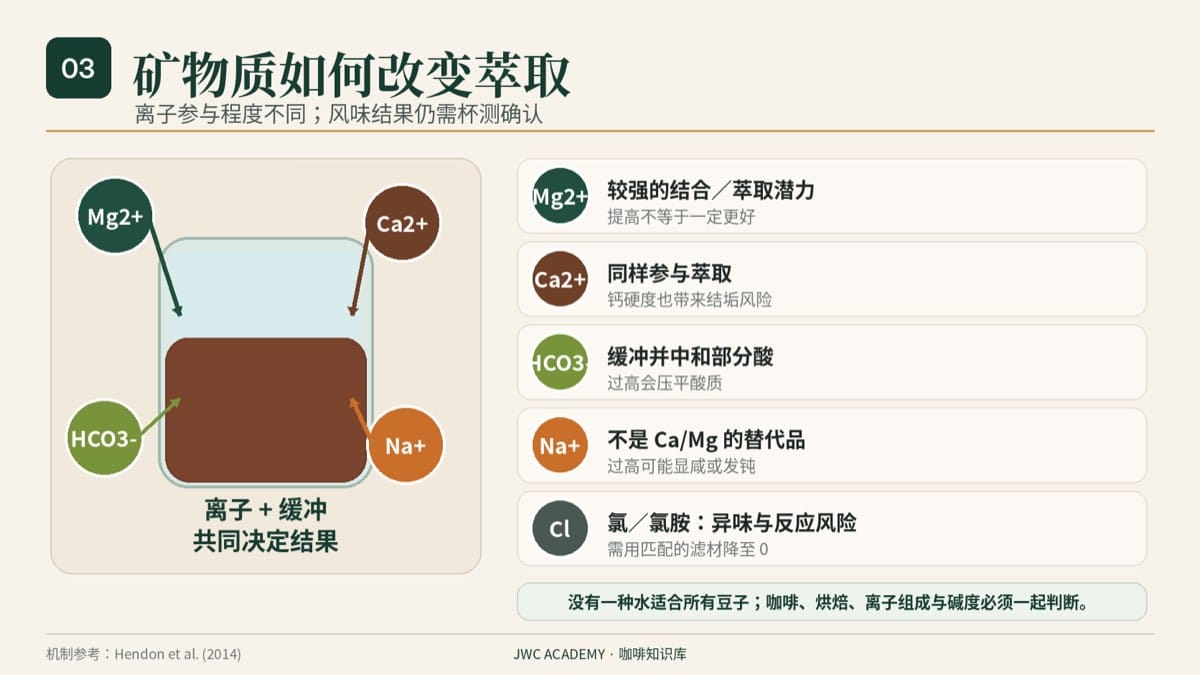
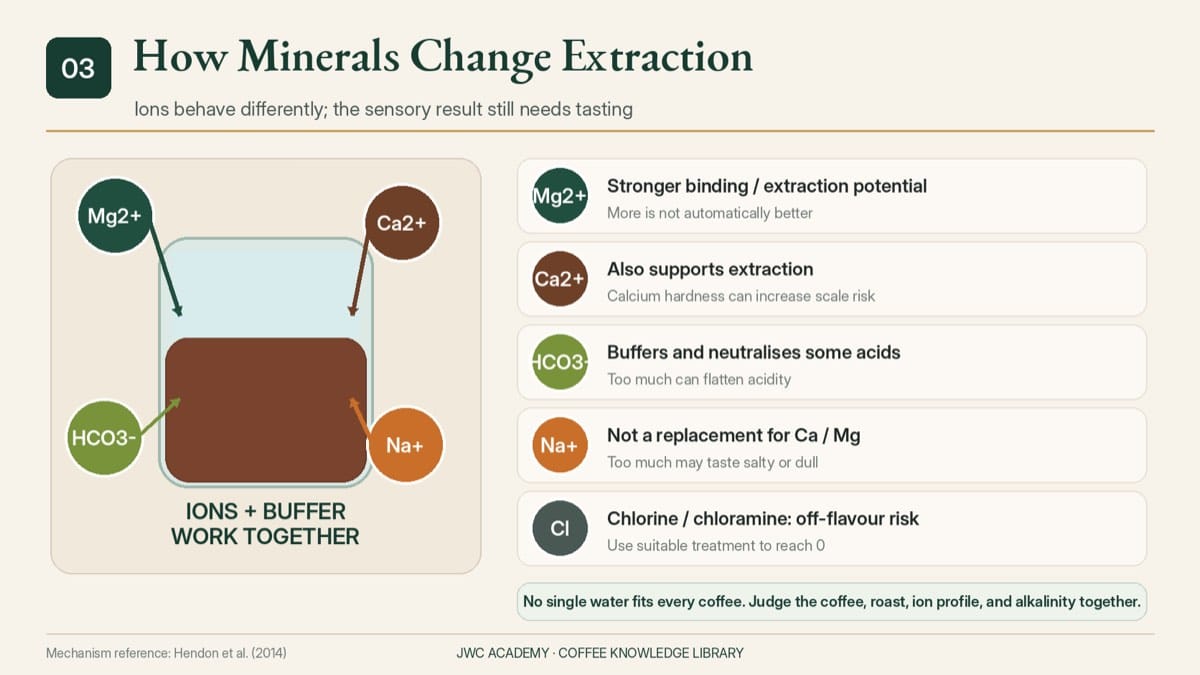
Where each mineral steers the cup
This is the heart of the advanced picture. Memorise this table and you can tune flavour with water.
The most efficient extractor. Pulls fruit acidity, florals, brightness, complexity. The soul of light roasts.
Calcium Ca²⁺
Brings body, sweetness, chocolate and nutty tones. Favoured for dark roasts and espresso.
Bicarbonate HCO₃⁻
Alkalinity/buffer. Neutralises acids: too low → sharp and unstable, too high → flat, dull, chalky.
Sodium Na⁺
At low levels lifts sweetness and roundness; too high turns flavour dull and salty.
Chlorine / chloramine
Tap-water disinfectant residue that forms off-flavours. Always carbon-filter before brewing.
One-line memory hook: Magnesium = bright (fruit, florals); Calcium = full (sweet, body); Bicarbonate = the brake (tames acid).
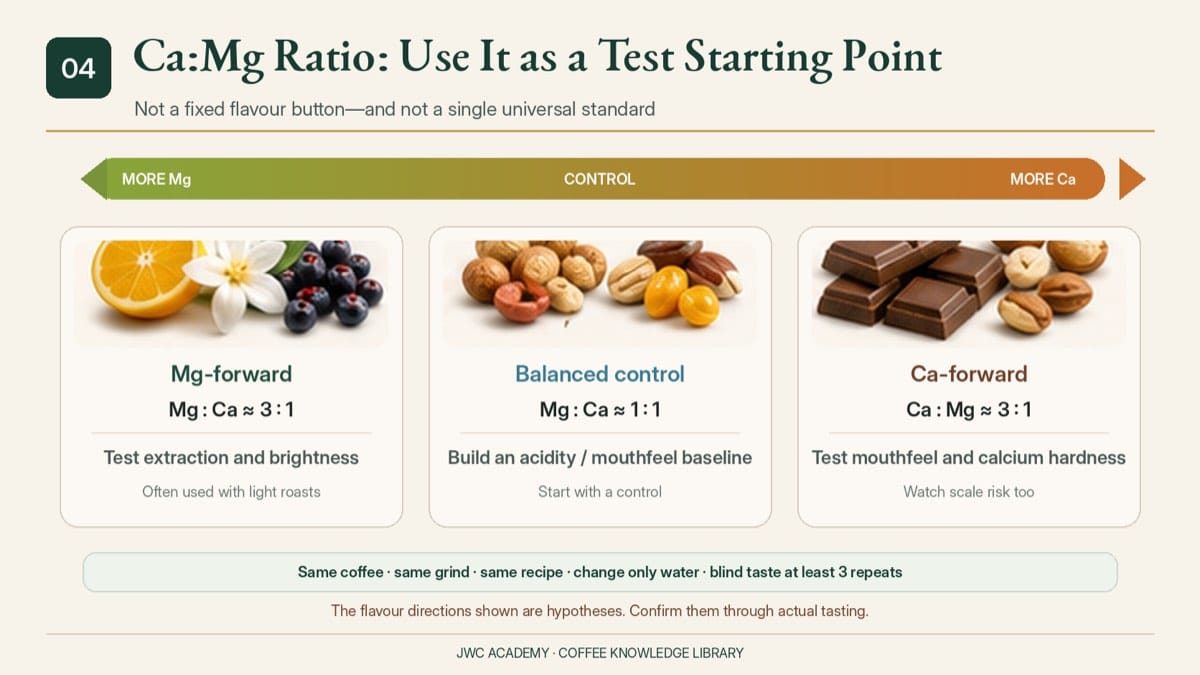
The Ca:Mg ratio sets the flavour direction
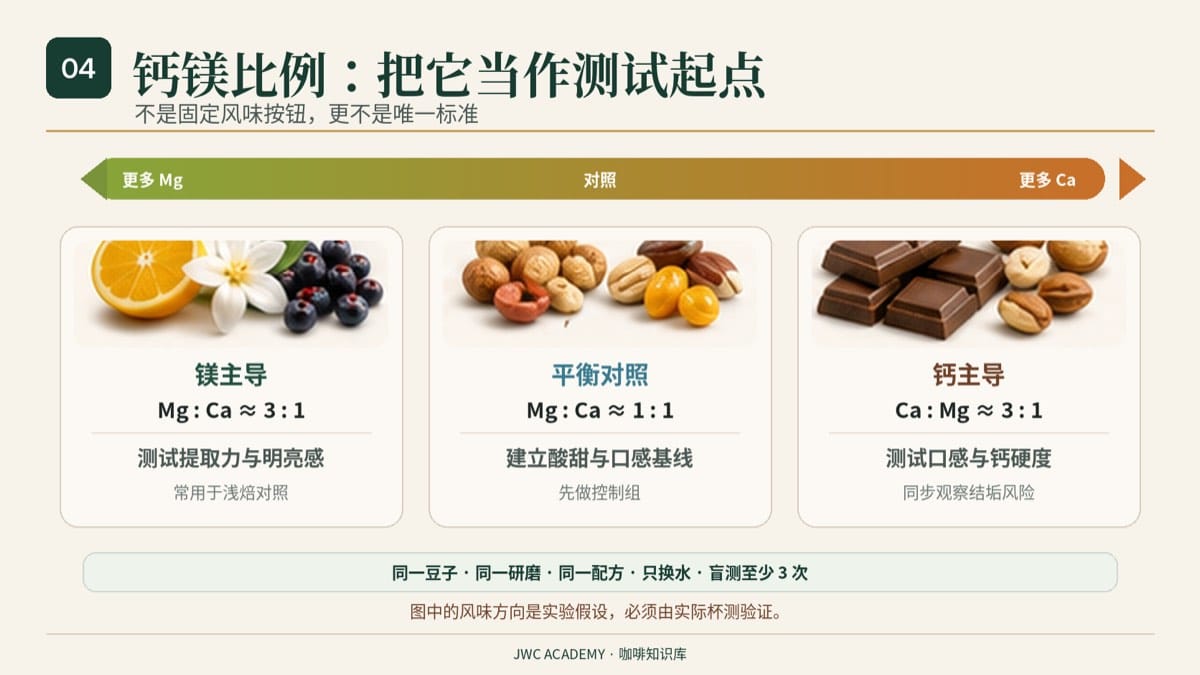
Since magnesium pulls brightness and calcium pulls body, the ratio between them is your flavour dial. Magnesium-led (Mg:Ca ≈ 3:1) → citrus, berry, florals with crisp acidity, great for light-roast single origins, pour-over; balanced (≈ 1:1) → even acidity and sweetness, the SCA all-round baseline, safe with any bean; calcium-led (Ca:Mg ≈ 3:1) → sweetness, chocolate, nutty depth, suits dark roast, espresso. This is exactly why competitors build custom water for different beans.
The Ca:Mg ratio moves flavour between Bright and Full
☕ Free interactive tool
Brew Water Recipe Calculator
Drag magnesium / calcium / alkalinity and get live salt doses in grams, a full water profile, a flavour prediction and an SCA check. Hands-on — see how the ratio changes the cup.
Works on phone & desktop · printable cheat sheet inside
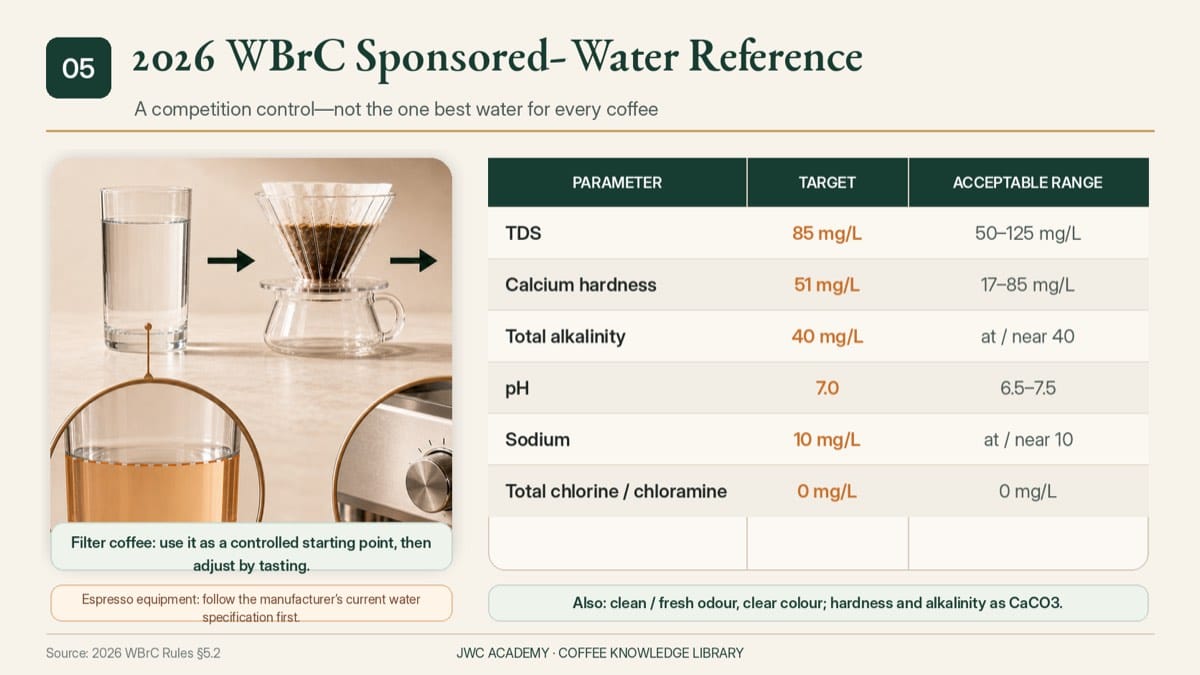
The SCA brewing water standard
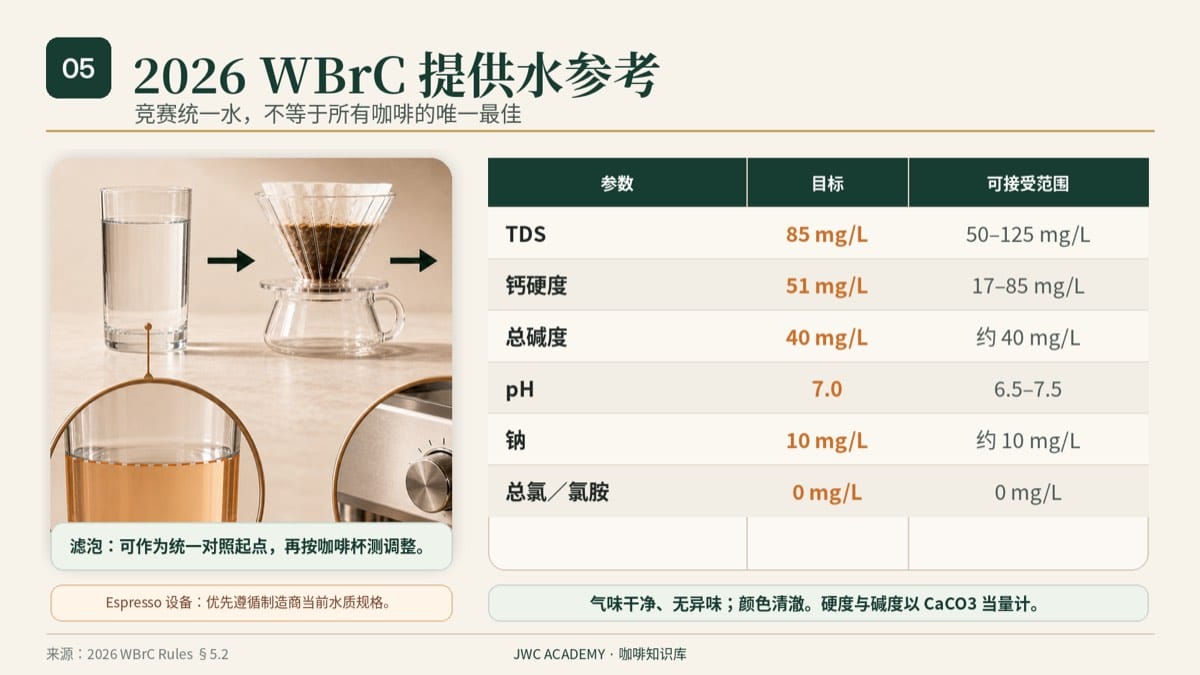
The Specialty Coffee Association publishes an industry-standard baseline. When you don’t know where to start, aim for these numbers. Hardness and alkalinity are expressed as calcium carbonate (CaCO₃) equivalent (mg/L = ppm).
Parameter
Target
Range
Why it matters
Total dissolved solids
150 mg/L
75 – 250
Overall drive for extraction
Total hardness (Ca+Mg)
68 mg/L
17 – 85
Extraction power; strength & scaling
Calcium hardness
51 mg/L
—
Body, sweetness, mouthfeel
Alkalinity (buffer)
40 mg/L
40 – 70
Buffers acids, stabilises flavour
pH
7.0
6.5 – 7.5
Overall acid–base balance
Sodium Na⁺
10 mg/L
—
Adds sweetness; dulls if too high
Chlorine (residual)
0 mg/L
0
Ruins flavour — filter it out
The WBrC reference water: targets and acceptable ranges
Build your own water: pure water + two salts
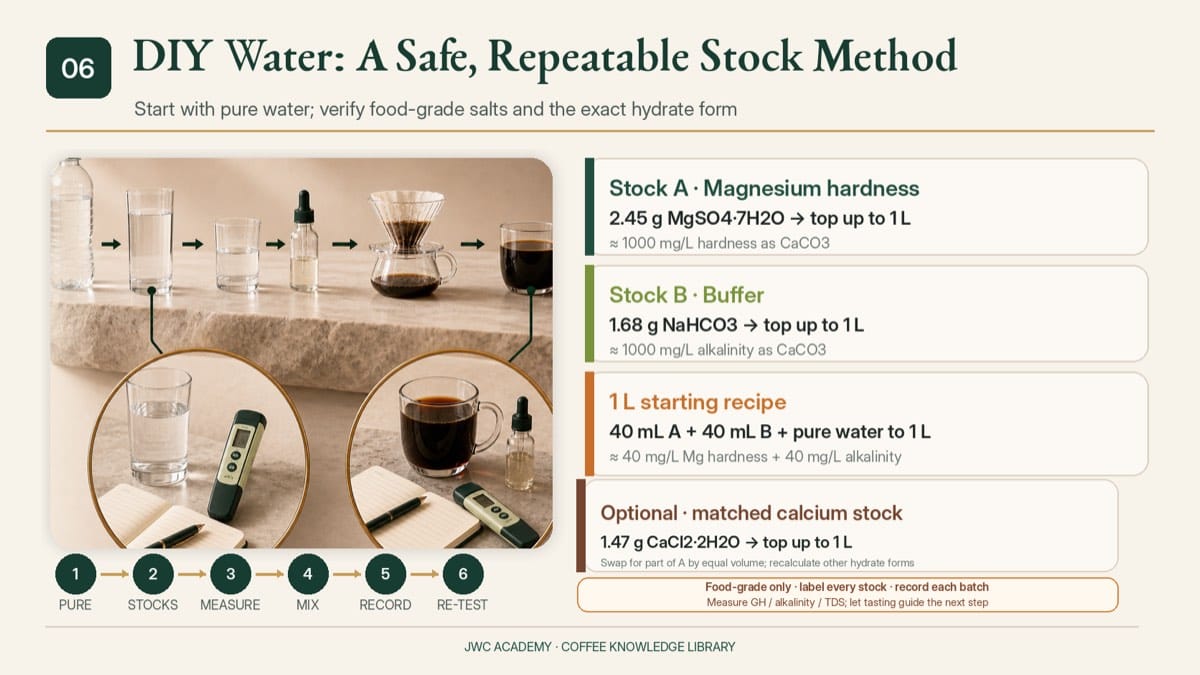
Once you understand the principles, you can build it yourself. Nearly every professional uses the same method: start from distilled or RO water (near-zero TDS) as a blank page, then add back exactly the minerals you want. Why not adjust tap water? Because you don’t know what’s already in it. Starting from zero is the only way to be fully in control.
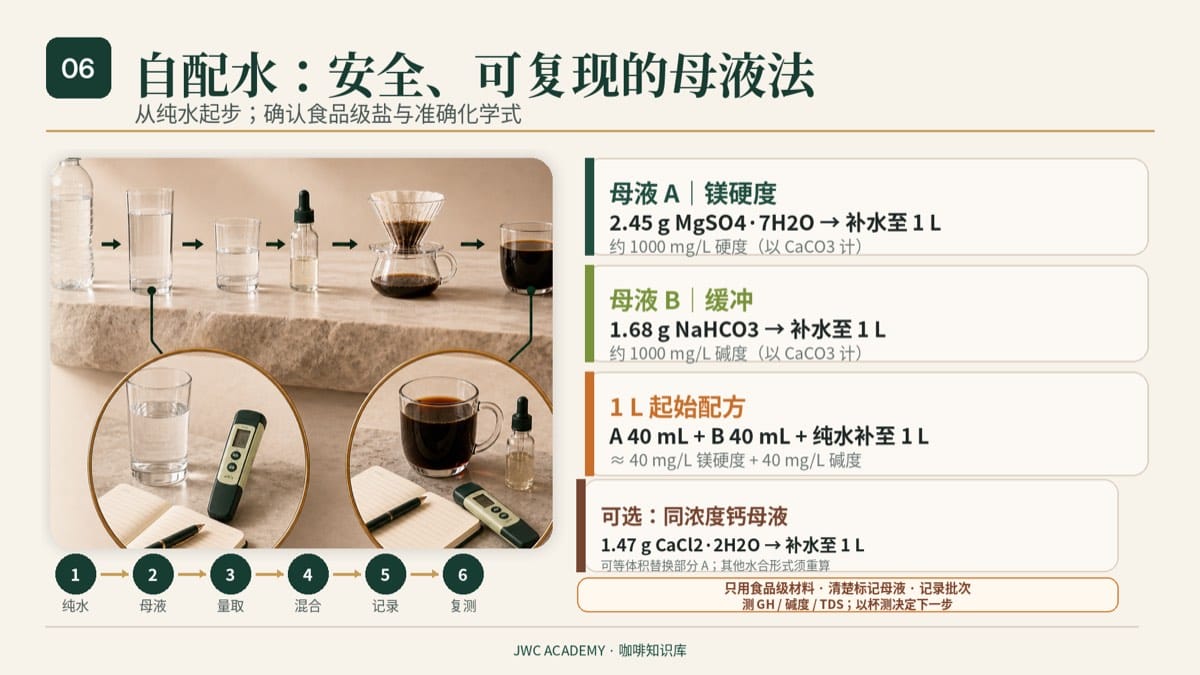
Home scales can’t weigh 0.1 g accurately, so make concentrated stock solutions and draw them by volume. Here’s the widely shared “magnesium bright” recipe:
Stock A (hardness): 2.45 g Epsom salt in 1 L distilled water
Stock B (buffer): 1.68 g baking soda in 1 L distilled water
Brew water: 40 mL Stock A + 40 mL Stock B, top up to 1 L with distilled water
Result: ≈ 40 mg/L Mg hardness + 40 mg/L alkalinity — close to the SCA balanced target
Want more body? Swap part of Stock A for a calcium-chloride stock (2.94 g CaCl₂·2H₂O / 1 L). Don’t want to memorise recipes? The water calculator takes your brew volume and tells you exactly how many grams of each salt to add.
Pure water + two salts: the stock-solution method for precise brew water
Yes, but choose carefully. Pick a low-mineral, low-alkalinity soft water (check the label) and avoid “hard” high-mineral waters. Brands vary a lot; find one that works and use it long-term.
Can I brew straight with distilled / RO water?
No. Pure water has almost no minerals, so extraction has no drive — the result is hollow, sour and thin. Pure water is a base to add salts to, not something to brew with directly.
Is a water filter enough?
A carbon filter removes chlorine and off-flavours, well worth doing. But it barely changes hardness or alkalinity — the calcium, magnesium and bicarbonate mostly stay. To control flavour, work with the water’s composition.
Can a TDS pen judge water quality?
Only partly. A TDS pen reads total dissolved solids and can’t distinguish calcium from magnesium from sodium bicarbonate. It helps you avoid extremes, but can’t reveal flavour direction. For precision, use a water report or recipe water.
Why does hard water ruin coffee?
Two reasons: hard water usually also has high alkalinity, which flattens acidity; and excess calcium and magnesium form limescale in kettles and machines, damaging equipment over time.
From theory to hands-on
Want to learn coffee extraction & water properly?
From extraction theory and water formulation to grind dial-in, our instructors take you step by step toward consistently great cups · from RM150 · real hands-on.
Message Cindy directly · she’ll recommend the best fit
Lucas Eng
Principal, Latte Art & Competition Coach at JWC Academy. 10th Place, 2017 World Latte Art Championship; three-time Malaysia Latte Art Champion. JWC Academy offers coffee, mixology, wine and baking training in Malaysia; course availability varies by programme and location.
function setLang(l){document.querySelectorAll(‘[data-lang]’).forEach(function(e){e.style.display=(e.getAttribute(‘data-lang’)===l)?”:’none’});document.querySelectorAll(‘.lang span’).forEach(function(s){s.classList.toggle(‘on’,s.getAttribute(‘data-l’)===l)});document.documentElement.lang=l;try{localStorage.setItem(‘jwclang’,l)}catch(e){}}
try{var s=localStorage.getItem(‘jwclang’);if(s){setLang(s)}}catch(e){}
window.addEventListener(‘scroll’,function(){var h=document.documentElement,b=document.body;var st=h.scrollTop||b.scrollTop,sh=(h.scrollHeight||b.scrollHeight)-h.clientHeight;var p=document.getElementById(‘progress’);if(p)p.style.transform=’scaleX(‘+(sh>0?(st/sh):0)+’)’}){“@context”:”https://schema.org”,”@graph”:[{“@type”:”Article”,”headline”:”The Complete Guide to Water for Coffee: How Minerals Decide Your Cup”,”inLanguage”:”en”,”datePublished”:”2026-08-17″,”dateModified”:”2026-08-17″,”image”:”https://jwcacademy.com/wp-content/uploads/2026/08/jwc-coffee-water-01_en.jpg”,”author”:{“@type”:”Person”,”name”:”Lucas Eng”,”jobTitle”:”Principal, Latte Art & Competition Coach, JWC Academy”,”award”:[“10th Place, 2017 World Latte Art Championship”,”Three-time Malaysia Latte Art Champion”],”sameAs”:[“https://digital.ucdavis.edu/item/ark:/87293/d36d5pn23″]},”publisher”:{“@type”:”Organization”,”name”:”JWC Academy”,”foundingDate”:”2009″,”logo”:{“@type”:”ImageObject”,”url”:”https://jwcacademy.com/wp-content/uploads/2024/01/logo.png”}}},{“@type”:”FAQPage”,”mainEntity”:[{“@type”:”Question”,”name”:”Can I brew coffee with bottled water?”,”acceptedAnswer”:{“@type”:”Answer”,”text”:”Yes, but choose carefully. Pick a low-mineral, low-alkalinity soft water and avoid hard high-mineral waters. Brands vary a lot; find one that works and use it long-term.”}},{“@type”:”Question”,”name”:”Can I brew straight with distilled or RO water?”,”acceptedAnswer”:{“@type”:”Answer”,”text”:”No. Pure water has almost no minerals, so extraction has no drive and the cup tastes hollow, sour and thin. Pure water is a base to add salts to, not something to brew with directly.”}},{“@type”:”Question”,”name”:”Is a carbon water filter enough for coffee?”,”acceptedAnswer”:{“@type”:”Answer”,”text”:”A carbon filter removes chlorine and off-flavours, which is worth doing, but it barely changes hardness or alkalinity. To control flavour you must work with the water’s mineral composition.”}},{“@type”:”Question”,”name”:”Can a TDS pen judge water quality for coffee?”,”acceptedAnswer”:{“@type”:”Answer”,”text”:”Only partly. A TDS pen reads total dissolved solids and cannot distinguish calcium, magnesium or sodium bicarbonate. It avoids extremes but cannot reveal flavour direction.”}},{“@type”:”Question”,”name”:”Why does hard water ruin coffee?”,”acceptedAnswer”:{“@type”:”Answer”,”text”:”Hard water usually has high alkalinity that flattens acidity, and its excess calcium and magnesium form limescale in kettles and espresso machines over time.”}}]}]}{“@context”:”https://schema.org”,”@type”:”HowTo”,”name”:”如何自己配咖啡冲煮水(母液法)”,”description”:”以蒸馏水/RO纯水为基底,加入两种食品级矿物盐,配出接近 SCA 均衡目标的冲煮水。”,”totalTime”:”PT10M”,”supply”:[{“@type”:”HowToSupply”,”name”:”蒸馏水 / RO 纯水(约 0 TDS)”},{“@type”:”HowToSupply”,”name”:”Epsom 泻盐 MgSO₄·7H₂O”},{“@type”:”HowToSupply”,”name”:”小苏打 NaHCO₃”}],”tool”:[{“@type”:”HowToTool”,”name”:”0.001 g 精密秤”}],”step”:[{“@type”:”HowToStep”,”position”:1,”name”:”配硬度母液 A”,”text”:”2.45 g Epsom 泻盐溶于 1 L 蒸馏水,得到镁硬度母液 A。”},{“@type”:”HowToStep”,”position”:2,”name”:”配缓冲母液 B”,”text”:”1.68 g 小苏打溶于 1 L 蒸馏水,得到碱度缓冲母液 B。”},{“@type”:”HowToStep”,”position”:3,”name”:”调配冲煮水”,”text”:”取母液 A 40 mL + 母液 B 40 mL,用蒸馏水补足至 1 L。”},{“@type”:”HowToStep”,”position”:4,”name”:”成品水质”,”text”:”约 40 mg/L 镁硬度 + 40 mg/L 碱度,贴近 SCA 均衡目标,适合浅焙到中焙。”}]}